Best miniature paint set
The right first paint set is not the biggest box on the shelf — it is the one that teaches you to paint. This guide compares sets on the four things that actually matter for a beginner: colour range, paint type, pigment and finish, and value. Get those right and a dozen pots will paint more models than a wall of a hundred ever will.
A note on how to read this. A set is a starting palette, not a complete collection — you will add and restock colours as you go. So the value here is the framework for choosing the first set, then a short list of picks once they are verified. Read the framework first, then look at the picks.
How to choose a paint set
Four things decide whether a set suits a beginner. Run any set through these — they are the columns in the comparison below.
Colours included — a dozen useful beats thirty random
The number on the box is the worst way to judge a set. What matters is whether the colours are useful: a couple of skin tones, a brown, the primaries, a black and a white give you a palette you can mix from. Thirty near-identical shades just take up space. The paints hub covers which core colours earn their place.
Paint type — basecoat, shade and metal from day one
The best beginner sets pair standard acrylics with at least one wash and a metallic, so you can basecoat, drop a wash into the recesses for instant depth, and pick out blades and armour without buying more. A set of standard acrylics alone still works, but you will want a wash almost immediately.
Pigment and finish — coverage in thin coats
Higher pigment means a colour covers well even when thinned, which is exactly what you want when you build two thin coats rather than one thick one. A matte finish suits most tabletop minis and takes a wash cleanly. Weak, watery pigment forces extra coats and frustrates a beginner.
Dropper or pot, and value — format matters more than you think
Dropper bottles waste less paint and make it easy to put a controlled drop on your palette, which supports the thin-your-paint habit. Open pots can dry out and tempt you to dip the brush in, loading the ferrule. Judge value by price per millilitre and how many of the colours you will actually use, not by the headline pot count.
The paint sets compared
A short list of widely available sets, compared on the four specs above plus format. Specs are verified against manufacturer data and current Amazon listings — no hands-on testing claims, just the numbers and the notes that decide the fit.
| Best for | Colours included | Paint type | Pigment / finish | Dropper / pot |
|---|---|---|---|---|
| Best overall | 50 (36 colours, 4 skin tones, 3 metallics, 3 effects, 4 washes) | Acrylic | High-pigment matte | Dropper bottles |
| Best budget | 18 (16 standard + metallic gold & silver) | Acrylic | Matte, UV-resistant | Dropper bottles |
| Best for beginners | 11 (7 colours, 2 metallics, 1 wash, 1 brush-on primer) | Acrylic | Matte | Dropper bottles |
| Best high-pigment / single-coat | 50 (46 Speedpaints incl. 3 metallics + 1 Speedpaint Medium) | Acrylic contrast / speed paint | Satin — self-shading, one-coat formula | Dropper bottles with stainless steel mixing balls |
| Best metallics set | 8 (Silver, Chainmail, Polished Gold, Glorious Gold, Bright Bronze, Brassy Brass, Hammered Copper, Tinny Tin) | Metallic acrylic | Metallic | Dropper bottles |
Our top picks
Best overall: The Army Painter Warpaints Fanatic Mega Paint Set, 50 Paints

Best overall
The Army Painter Warpaints Fanatic Mega Paint Set, 50 Paints
The Army Painter
- Colours included: 50 (36 colours, 4 skin tones, 3 metallics, 3 effects, 4 washes)
- Paint type: Acrylic
- Pigment / finish: High-pigment matte
- Bottle / pot size: 18ml
- Dropper / pot: Dropper bottles
- Best for: All-round miniature painting — Warhammer, D&D, board games
The Warpaints Fanatic Mega Set packs 50 carefully curated paints into high-pigment dropper bottles, covering every category a miniature painter needs — bases, washes, skin tones, metallics, and effects. Includes an MDF paint station and a free brush.
Last checked 2026-05-21
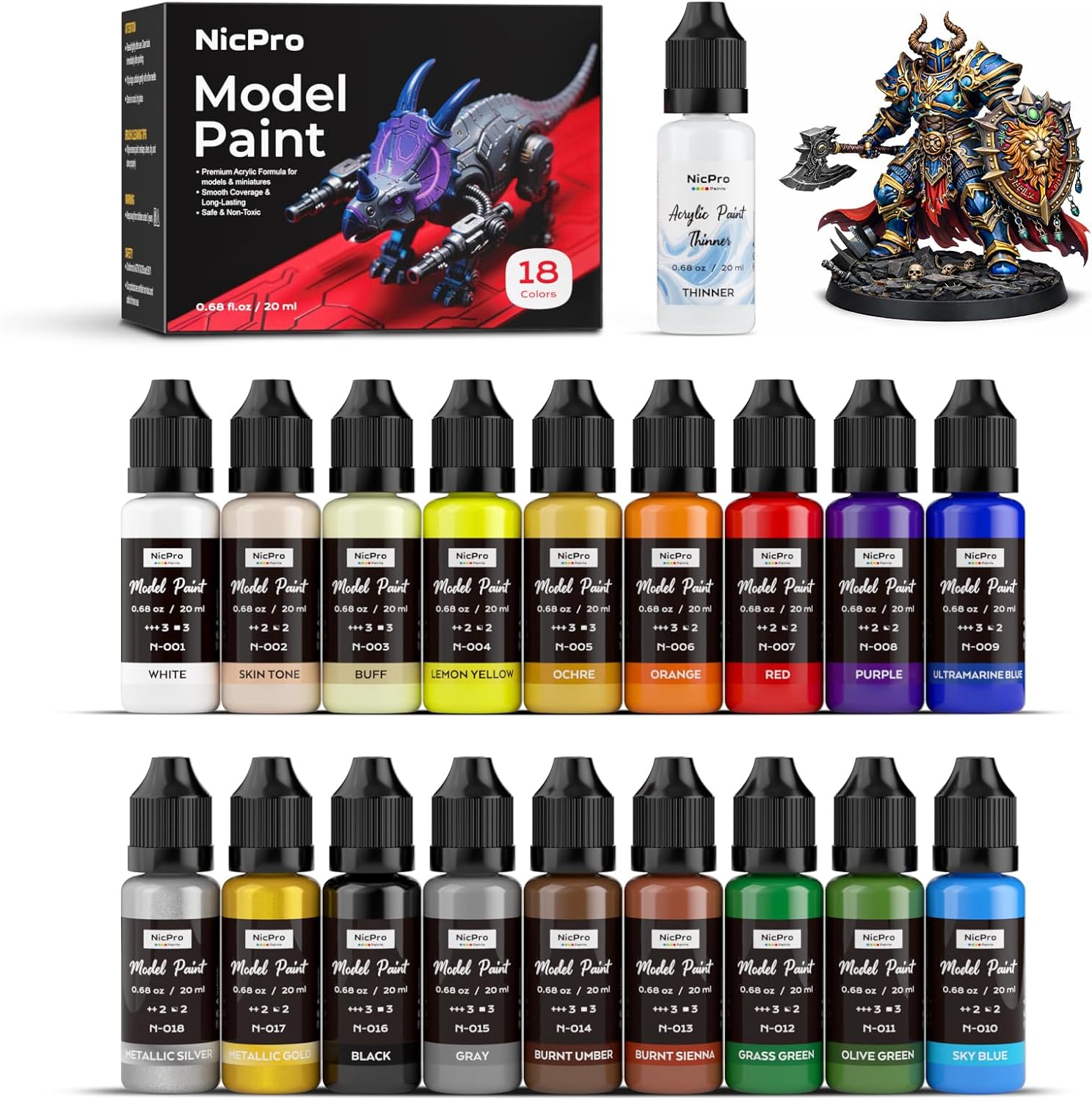
Best budget: Nicpro 18 Colors Model Paint Set, 20ml Acrylic Paints with Thinner
Best budget
Nicpro 18 Colors Model Paint Set, 20ml Acrylic Paints with Thinner
Nicpro
- Colours included: 18 (16 standard + metallic gold & silver)
- Paint type: Acrylic
- Pigment / finish: Matte, UV-resistant
- Bottle / pot size: 20ml
- Dropper / pot: Dropper bottles
- Best for: First-time painters on a tight budget
Pre-thinned and ready to use straight from the dropper, the Nicpro set offers 20ml bottles — larger than most at this price — plus a paint thinner for diluting for airbrush use. Brush and airbrush compatible, drying to a matte, UV-resistant finish.
Last checked 2026-05-21
Best for beginners: The Army Painter Warpaints Fanatic Starter Set — 11 Paints incl. Primer, Miniature & Brush

Best for beginners
The Army Painter Warpaints Fanatic Starter Set — 11 Paints incl. Primer, Miniature & Brush
The Army Painter
- Colours included: 11 (7 colours, 2 metallics, 1 wash, 1 brush-on primer)
- Paint type: Acrylic
- Pigment / finish: Matte
- Bottle / pot size: 18ml
- Dropper / pot: Dropper bottles
- Best for: Complete beginners — includes primer, miniature, brush, and painting guide
Purpose-built for first-timers, this starter set ships with a brush-on primer, a 28mm miniature, and a step-by-step painting guide — so the only other requirement is a brush. The 11 Fanatic paints cover every core technique: base coating, washing, and metallic highlights.
Last checked 2026-05-21
Best high-pigment / single-coat: The Army Painter Speedpaint Mega Set 2.0 — 50 x 18ml Contrast Paints

Best high-pigment / single-coat
The Army Painter Speedpaint Mega Set 2.0 — 50 x 18ml Contrast Paints
The Army Painter
- Colours included: 50 (46 Speedpaints incl. 3 metallics + 1 Speedpaint Medium)
- Paint type: Acrylic contrast / speed paint
- Pigment / finish: Satin — self-shading, one-coat formula
- Bottle / pot size: 18ml
- Dropper / pot: Dropper bottles with stainless steel mixing balls
- Best for: Speed painting armies — one coat from primer to shaded finish
Speedpaint 2.0 flows over primed miniatures and self-shades into recesses in a single coat, creating instant highlights and saturation without layering. The reformulated 2.0 version fixes the reactivation issues of the original, and includes three first-of-their-kind Speedpaint Metallics.
Last checked 2026-05-21
Best metallics set: Vallejo Game Color Metallic Colors, 8 x 18ml Dropper Bottles

Best metallics set
Vallejo Game Color Metallic Colors, 8 x 18ml Dropper Bottles
Vallejo
- Colours included: 8 (Silver, Chainmail, Polished Gold, Glorious Gold, Bright Bronze, Brassy Brass, Hammered Copper, Tinny Tin)
- Paint type: Metallic acrylic
- Pigment / finish: Metallic
- Bottle / pot size: 18ml
- Dropper / pot: Dropper bottles
- Best for: Armour, weapons, coins, and fantasy metallic detail on miniatures
Vallejo's Game Color Metallic set covers all the essential fantasy metallics — two golds, two silvers, bronze, brass, copper, and iron — in precision eyedropper bottles that allow controlled dispensing and easy thinning. The water-based metallic formula is a long-standing industry standard.
Last checked 2026-05-21
Who should buy what
Brand-new painters
A balanced set of a dozen standard acrylics plus a wash and a metallic does everything you need while you learn. Do not overthink it, and do not buy the giant box — a small, useful palette teaches you to mix and to thin, which matters far more than owning every colour.
Batch and army painters
If you have a pile of models to get tabletop-ready, look for a set that leans on one-coat high-pigment paints, which colour and shade in a single pass and save real time across dozens of minis. Pair it with an airbrush for priming once the batch grows.
Detail and display painters
Standard acrylics give the most control for layering and blending, so a high-pigment standard set with a wide colour spread suits careful work. Add specific colours as a scheme demands rather than buying everything at once.
What pairs with your paint set
Paint is half the equation — the brush is the other half, and a good brush kept in shape does as much for clean results as the paint itself. If you are assembling a first kit, the most efficient next buy is a small set of brushes chosen for tip retention and the right sizes: see the best miniature paint brushes guide for how bristle, size and care decide the fit. The paints hub goes deeper on the four paint types if you want the background first.
Frequently asked questions
How many colours does a beginner paint set need?
About a dozen well-chosen colours does more than thirty random ones. You want a couple of skin tones, a brown, a red, a blue, a green, a yellow, a black and a white, plus a dark wash and a metallic. From those you can mix most of what you need and learn how colours behave. A huge set mostly adds pots you will rarely open.
Are dropper bottles or pots better?
Dropper bottles waste less paint and make it easier to put a controlled amount on your palette, which suits the thin-your-paint habit. Open pots can dry out and tempt you to dip the brush straight in, which loads paint into the ferrule. Neither is wrong, but droppers are friendlier for a beginner learning to thin paint.
Can I use craft-store acrylic paint on miniatures?
You can, but it is not ideal for fine detail. Craft acrylics are formulated for larger surfaces, so the pigment is coarser and the paint is thicker, which clogs the sculpted detail on a miniature. Hobby acrylics are ground finer and sit in thin coats without burying detail. A craft paint is fine for terrain or a base, less so for a face.
Should a first set include washes and metallics?
Ideally yes. A wash gives instant depth by flowing into the recesses, and it is the fastest way to make a flat basecoat look finished. A metallic or two covers blades, armour and trim. A set that pairs standard acrylics with at least one wash and a metallic lets you basecoat, shade and pick out metal from your first model.
What is the difference between standard and one-coat high-pigment paint?
Standard acrylics are thinned and built up in two or three thin coats, giving you the most control. One-coat high-pigment paints colour and shade in a single pass — they pool darker in recesses and sit lighter on raised areas — which is faster for getting a batch tabletop-ready. Beginners often learn on standard acrylics and add one-coat paints for speed later.
Do I need to thin paint from a beginner set?
Yes, almost always. Even a good set is too thick straight from the pot for a miniature, and thick paint hides detail and dries with brush marks. Thin standard acrylics to the consistency of milk and build two thin coats. Washes come pre-thinned and one-coat paints need little or none, but everyday colours need thinning. It is the single biggest fix for beginner results.
How long does a beginner paint set last?
Longer than you expect, because you use thin coats. A first set of a dozen colours can carry you through dozens of models before you run low on the colours you use most, like skin, brown and black. You will restock your most-used pots first and add new colours as you take on new schemes, which is why monthly top-ups are normal once you are painting regularly.